
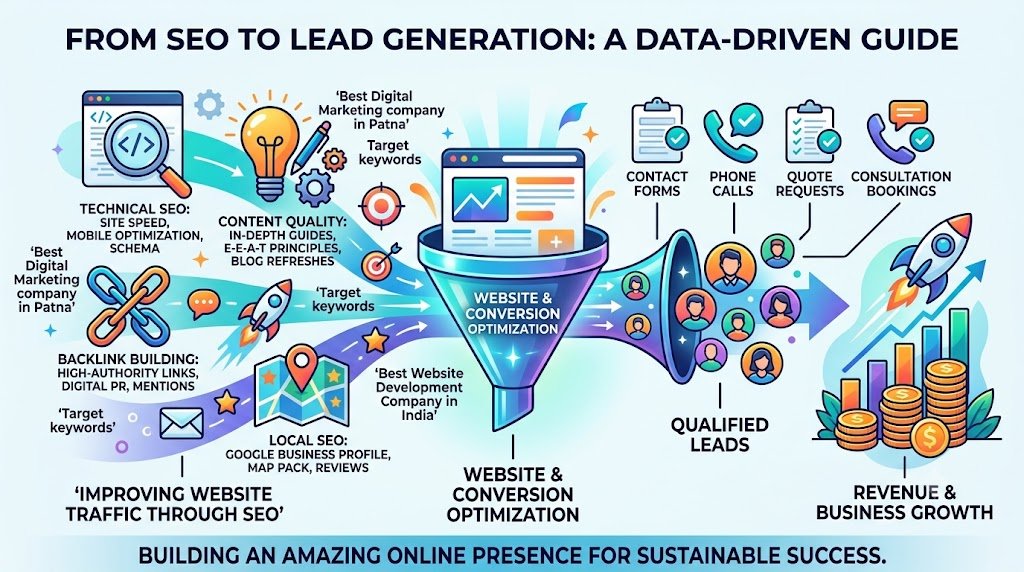
In the modern digital economy, traditional outbound marketing strategies—such as cold calling, unsolicited emails, and intrusive billboard advertising—are rapidly losing their efficacy. Consumers and B2B buyers alike have become adept at tuning out interruptions. Instead, when they face a problem, they turn to search engines.
Search Engine Optimization (SEO) has evolved from a simple tactic for gaining website traffic into a sophisticated, highly targeted engine for lead generation. But how exactly does ranking on Google translate to a user submitting their contact information, requesting a quote, or signing up for a consultation?
This in-depth guide explores the mechanics of how SEO helps generate high-quality leads for businesses. We will dive into the psychology of search intent, the architecture of a lead-generating website, and how partnering with top-tier agencies like Buzz Boosting can transform your digital presence into a 24/7 lead-generation machine.
1. The Psychology of Search: Capturing High-Intent Users
The most significant advantage SEO has over other marketing channels is user intent. When a user types a query into Google, they are actively looking for a solution, a product, or information. They are already further down the sales funnel than someone casually scrolling through a social media feed.
In-Depth Explanation
Search intent is generally categorized into four types:
- Informational: The user wants to learn something (e.g., “how to fix low website traffic”).
- Navigational: The user is looking for a specific website (e.g., “Buzz Boosting login”).
- Commercial Investigation: The user is researching options before buying (e.g., “top SEO agencies near me”).
- Transactional: The user is ready to buy (e.g., “hire SEO expert online”).
SEO generates leads by targeting users at the Commercial and Transactional stages, while using Informational content to build trust early in the buyer’s journey. By mapping keywords to these specific intents, a business ensures that the traffic arriving on its site is highly qualified and ready to engage.
Example in Practice
Imagine a company that sells enterprise cybersecurity software. If they rely on cold calling, they might call 100 IT directors, 99 of whom are not currently looking for new software.
However, if they use SEO to rank on the first page of Google for the keyword “best ransomware protection software for hospitals,” every single visitor clicking on that link has a pressing, immediate need. When these visitors arrive on a landing page offering a free network security audit in exchange for their email address and phone number, the conversion rate from visitor to lead will be astronomically higher than outbound methods.
2. Targeted Keyword Strategy: Quality Over Quantity
Traffic is a vanity metric; leads are a business metric. Getting 10,000 visitors a month means nothing if none of them fit your ideal customer profile (ICP). SEO generates leads through the meticulous selection of long-tail keywords.
In-Depth Explanation
Short-tail keywords are broad (e.g., “shoes” or “marketing”). They have massive search volume but terrible conversion rates because the intent is too vague. Long-tail keywords are specific, usually containing three or more words (e.g., “men’s waterproof trail running shoes size 10” or “B2B SaaS marketing agency”).
A robust SEO strategy identifies the exact phrases your target audience uses when they are ready to become a lead. By optimizing specific landing pages for these hyper-targeted long-tail keywords, businesses filter out irrelevant traffic and attract users who know exactly what they want.
Example in Practice
Consider a boutique accounting firm. If they try to rank for “accountant,” they will compete with global firms and Wikipedia, and the traffic might consist of students looking for career advice.
Instead, they target the long-tail keyword “startup tax preparation services in Austin.” The search volume might only be 150 searches a month, but those 150 people are startup founders in Austin actively seeking tax help. The firm creates a dedicated landing page for this service, complete with a “Schedule a Free Consultation” form. By ranking #1 for this specific term, those 150 searches might yield 15 highly qualified leads every month.
3. High-Quality Content Marketing: Building Trust and Gating Assets
SEO and Content Marketing are inextricably linked. You cannot rank without content, and content is invisible without SEO. However, content does more than just attract search engine crawlers; it builds the necessary trust required for a user to hand over their personal information.
In-Depth Explanation
To generate leads, your content must solve a problem. When a user reads a comprehensive blog post or a case study on your website that accurately diagnoses their pain points and offers actionable solutions, you establish E-E-A-T (Experience, Expertise, Authoritativeness, and Trustworthiness).
Once trust is established, SEO utilizes Lead Magnets. A lead magnet is a high-value piece of downloadable content—such as an e-book, a whitepaper, a template, or an industry report—that is “gated” behind a form. The user finds your site via an organic search, reads a helpful article, and is then offered the gated asset in exchange for their name and email address.
Example in Practice
A real estate agency writes a detailed, SEO-optimized blog post titled “The Ultimate Guide to Buying Your First Home in 2024.” The post ranks well and brings in thousands of organic visitors.
At the end of the post (and in sidebars), they place a Call-to-Action (CTA): “Download our Free First-Time Homebuyer’s Financial Checklist.” To get the checklist, the user must provide their email and check a box indicating when they plan to buy a home (e.g., 1-3 months, 3-6 months). The SEO-driven traffic is seamlessly converted into a segmented list of warm leads that the real estate agents can now nurture through email marketing.
4. Local SEO: Dominating Geo-Specific Lead Generation
For service-based businesses, brick-and-mortar stores, and regional agencies, Local SEO is the most powerful lead-generation tool available. A significant percentage of all Google searches have local intent (e.g., “plumber near me”).
In-Depth Explanation
Local SEO involves optimizing your digital footprint to appear in the Google Local Pack (the map and three business listings that appear at the top of local searches). This is achieved by optimizing your Google Business Profile (GBP), ensuring NAP (Name, Address, Phone Number) consistency across online directories, and gathering positive customer reviews.
Local SEO removes friction from the lead generation process. A user searching on their mobile phone can click a single “Call Now” button directly from the search results, instantly becoming a lead without ever even visiting your website.
Example in Practice
Suppose a local business owner wants to revamp their online presence. They search for the Best Digital Marketing company in Patna.
If Buzz Boosting has optimized its Google Business Profile, accrued positive reviews, and created locally targeted landing pages, it will appear in the top three map results. The business owner sees the 5-star rating, clicks the “Website” link, and fills out the contact form. Furthermore, because Buzz Boosting targets specific regional keywords, they capture leads from business owners who specifically want a local partner they can meet with face-to-face.
5. Technical SEO and User Experience (UX): Sealing the Leaks in the Funnel
You can have the best content in the world and target the perfect keywords, but if your website is technically flawed, your lead generation efforts will fail. Technical SEO ensures that search engines can crawl and index your site, but more importantly, it ensures a frictionless User Experience (UX).
In-Depth Explanation
Google factors Core Web Vitals (loading speed, interactivity, and visual stability) into its ranking algorithm. A slow website not only ranks lower but also suffers from massive bounce rates. Research shows that if a page takes longer than three seconds to load, over 50% of users will abandon it. A user who bounces is a lead lost forever.
Furthermore, mobile responsiveness is critical. With over 60% of global web traffic coming from mobile devices, a site that is difficult to navigate on a smartphone will fail to capture leads. Forms must be easy to tap, text must be legible without zooming, and navigation must be intuitive.
Example in Practice
An e-commerce brand notices a massive drop in wholesale inquiry leads despite stable organic traffic. A technical SEO audit reveals that their newly updated contact form script is causing a 5-second delay on mobile devices. Users are tapping the page, getting frustrated, and leaving.
By hiring the Best Website Development Company in Patna to rebuild their site architecture, they improve their load time to under 1.5 seconds and streamline the mobile form. Not only do their organic rankings improve due to better Core Web Vitals, but their lead conversion rate skyrockets because the friction was removed. For businesses looking for elite technical infrastructure, partnering with the Best Website Development Company in India ensures that your site is built to handle traffic and convert it flawlessly.
6. Backlinks and Brand Authority: The Endorsement Effect
In the realm of SEO, backlinks (links from other reputable websites to your website) act as votes of confidence. While backlinks are primarily known as a ranking factor, they play a profound psychological role in lead generation.
In-Depth Explanation
When high-authority, relevant websites link to your content, Google views your site as credible and pushes you higher in the Search Engine Results Pages (SERPs). But consider the human element: when a user is reading an article on an industry-leading publication (like Forbes, TechCrunch, or a major trade magazine) and clicks a link recommending your business as a solution, they arrive on your site with pre-established trust.
This referral traffic often has a much higher conversion rate than standard organic search traffic because the third-party endorsement validates your authority.
Example in Practice
A financial consulting firm writes a groundbreaking piece of original research on market trends. A major financial news network quotes this research and links back to the firm’s website.
Readers of the news network click the link to read the full report. Because they already trust the news network, they extend that trust to the consulting firm. When they arrive on the firm’s landing page, they are highly receptive to the CTA: “Speak with one of our analysts today.” The backlink not only boosted the firm’s overall SEO but served as a direct conduit for high-ticket leads.
7. Conversion Rate Optimization (CRO) Integrated with SEO
SEO brings the horse to water; CRO makes it drink. The most successful lead generation campaigns do not treat SEO and CRO as separate entities; they integrate them seamlessly.
In-Depth Explanation
An SEO campaign designed for lead generation continually analyzes user behavior metrics—such as time on page, scroll depth, and form abandonment rates—using tools like Google Analytics 4 (GA4) and heat mapping software (like Hotjar).
If a page ranks #1 and gets 5,000 visitors but only generates 2 leads, the SEO job isn’t finished. The focus shifts to analyzing the page layout. Is the CTA hidden at the bottom? Is the lead form asking for too much information (e.g., asking for a home address when only an email is needed)? By A/B testing different headlines, form placements, and button colors on high-traffic organic pages, businesses can exponentially increase their lead volume without needing to generate a single extra visitor.
Example in Practice
A B2B logistics company ranks well for “freight forwarding services.” Their original page features a massive wall of text and a tiny “Contact Us” link at the very bottom. Their organic traffic is high, but leads are low.
They implement an SEO/CRO hybrid approach: They break the text into readable bullet points (which also helps win Google Featured Snippets), add a floating CTA button that scrolls with the user on mobile, and reduce their contact form from 8 fields to just 3 (Name, Email, Volume). The result is a 300% increase in leads generated from the exact same amount of organic SEO traffic.
Conclusion: Turning Search Engine Visibility into Tangible Business Growth
SEO is not a dark art, nor is it merely a mechanism for driving empty numbers to a website. When executed correctly, it is the most sustainable, cost-effective, and high-converting lead generation strategy available to modern businesses.
By understanding user intent, targeting specific long-tail keywords, producing authoritative content, dominating local search, and maintaining flawless technical website performance, you align your business perfectly with the exact moment a potential customer is looking for a solution.
However, orchestrating a campaign that successfully integrates content, technical SEO, and conversion optimization requires a dedicated team of experts. You need a partner who understands both the algorithms of search engines and the psychology of human buyers.
This is where Buzz Boosting steps in. Recognized for delivering phenomenal ROI, Buzz Boosting combines cutting-edge SEO tactics with elite web infrastructure to ensure your website doesn’t just rank—it generates revenue. Whether you are looking for the Best Digital Marketing company in Patna to dominate your local market, or seeking the expertise of the Best Website Development Company in India to build a high-converting digital storefront, Buzz Boosting provides the data-driven strategies necessary to turn your website into your most valuable sales asset. Start treating your website as a lead-generation engine today, and watch your business grow organically.