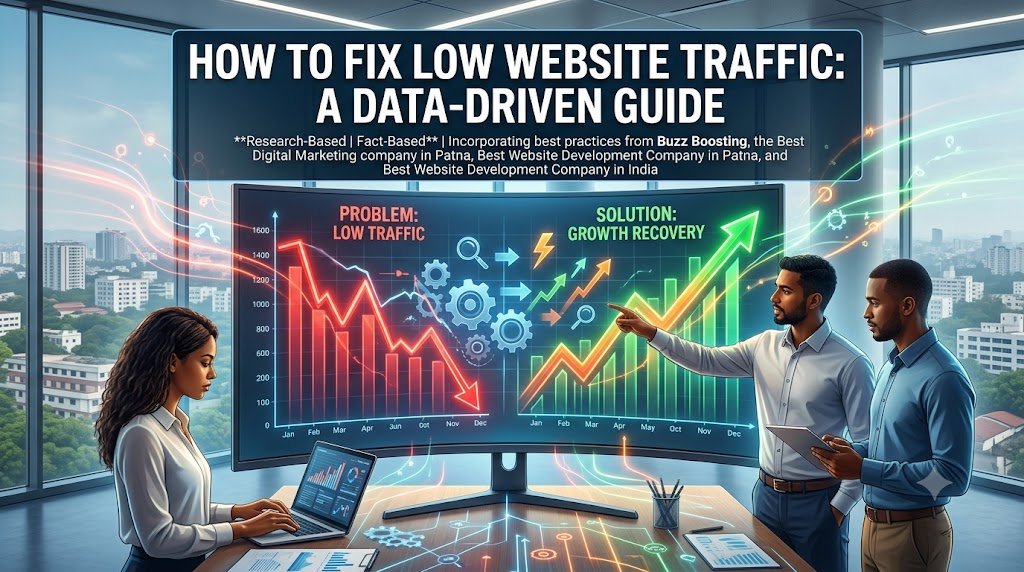
A sudden or gradual decline in website traffic is a common nightmare for business owners and digital marketers alike. Whether you’re managing a growing startup or an established enterprise, seeing your analytics dashboard flash red can cause immediate panic. But traffic drops rarely happen without a reason.
In this comprehensive guide, we will explore the root causes of low website traffic, how to accurately diagnose them, and actionable, research-backed strategies to fix the problem. We will also explore how partnering with the right experts, such as Buzz Boosting, the Best Digital Marketing company in Patna, can turn your traffic woes into a powerful engine for digital growth.
Part 1: Diagnosing the Drop — Is It Real, or Is It a Glitch?
Before executing massive changes to your content or technical infrastructure, you must confirm that the traffic drop is legitimate. Data anomalies or tracking errors often masquerade as traffic crises.
1. Verify Your Tracking Infrastructure
A broken tracking code will report zero visitors even if thousands are browsing your site.
- The Fix: Check your Google Analytics 4 (GA4) property and Google Tag Manager (GTM) containers. Ensure tags are firing correctly on all pages, especially if you recently updated your site’s theme, changed your consent banner, or migrated domains.
- Example: A local retail store panicked over a 90% traffic drop. An audit revealed their new cookie consent banner was blocking GA4 scripts from firing until users explicitly clicked “Accept All,” artificially deflating their numbers.
2. Differentiate Between a Drop and a Trend
Traffic fluctuates due to seasonality, changing consumer behaviors, or broader economic trends.
- The Fix: Compare your current traffic year-over-year (YoY) rather than month-over-month (MoM). Use Google Trends to check if the overall search volume for your core services has decreased.
- Example: A company selling winter gear noticed a severe traffic dip in March. A YoY analysis showed this was a predictable seasonal trend, not a penalty or SEO failure.
3. Segment the Traffic Loss
Traffic doesn’t usually drop equally across all channels.
- The Fix: Look at your Acquisition reports in GA4. Is the drop isolated to Organic Search, Social, Direct, or Referral traffic? If Organic Search plummeted but Social remains steady, you have an SEO issue. If Direct traffic fell off a cliff, check for broken redirects or offline marketing campaign pauses.
Part 2: The Core Causes of Low Website Traffic (And How to Fix Them)
If you’ve confirmed the drop is real and isolated it to organic search, it’s time to investigate the three main pillars of SEO: Technical, Content, and Authority.
1. Technical SEO Failures: The Invisible Barriers
Search engine bots (like Googlebot) must be able to crawl, render, and index your pages. If they can’t, your content will never rank, regardless of how good it is.
- Crawl Errors and Indexing Issues: A stray robots.txt rule or an accidental noindex tag can wipe out your visibility overnight. Use Google Search Console’s (GSC) Page Indexing report to spot pages Google refuses to index.
- Redirect Chains and Broken Links: Site migrations often lead to broken URLs (404 errors) or endless redirect loops, frustrating both users and search bots.
- Site Speed and Core Web Vitals: Google uses Core Web Vitals (Largest Contentful Paint, Cumulative Layout Shift, and Interaction to Next Paint) as ranking signals. Slow sites have higher bounce rates and receive less crawl budget.
The Fix: Conduct a comprehensive technical SEO audit. Ensure your XML sitemaps are clean (containing only indexable, 200 OK pages), fix broken internal links, and compress images to improve loading speed.
Need Help? Fixing technical SEO requires expertise. As the Best Website Development Company in Patna, Buzz Boosting builds blazing-fast, technically sound, and SEO-optimized websites from the ground up to ensure search engines love your site as much as your users do.
2. The Content Crisis: Failing the “Helpful Content” Test
Google’s algorithm updates, particularly the Helpful Content Update (HCU), have aggressively targeted low-quality, AI-generated spam, or content created purely to manipulate rankings. If your content doesn’t prioritize the user experience, your traffic will suffer.
- Search Intent Mismatch: If a user searches for “how to fix a leaky faucet” (informational intent) and your page only tries to sell them plumbing services (transactional intent), Google will drop your ranking.
- Thin or Outdated Content: Pages with low word counts, superficial information, or outdated statistics lose ground to competitors providing comprehensive, up-to-date guides.
- Lack of E-E-A-T (Experience, Expertise, Authoritativeness, Trustworthiness): Google favors content written by recognized experts with firsthand experience.
The Fix: Audit your content portfolio. Update decaying articles with fresh data, expert quotes, and better formatting (like bullet points and tables). Ensure every page clearly answers the searcher’s query.
Case Study Example: A medical hospital published content in multiple languages and emphasized EEAT by including expert author bios, citations, and structured data. This multi-regional approach, backed by strong trust signals, resulted in a massive traffic increase and top rankings for highly competitive health queries.
3. Algorithm Updates and SERP Feature Changes
Sometimes, traffic drops aren’t your fault. Google continuously updates its algorithms, which can shuffle rankings. Furthermore, Google frequently changes the layout of the Search Engine Results Page (SERP). The introduction of AI Overviews or more aggressive Featured Snippets can answer a user’s question directly on Google, resulting in a “zero-click search” where you lose traffic even if your ranking remained identical.
The Fix: Monitor Google’s Search Status Dashboard for confirmed updates. If an update hits, wait for it to finish rolling out before making drastic changes. To combat zero-click searches, focus on complex, long-tail keywords that require deep explanations that AI overviews cannot fully satisfy.
Part 3: Strategies to Boost and Sustain Website Traffic
Fixing a drop is only half the battle; the goal is consistent, scalable growth.
1. Build a Topical Authority Hub
Instead of publishing random blog posts, organize your content into “clusters”. Create a comprehensive “pillar” page on a broad topic (e.g., “Digital Marketing Guide”) and link it to numerous “cluster” pages covering specific subtopics (e.g., “SEO Strategies,” “PPC Tips”). This internal linking structure signals to Google that you are a topical authority.
2. Optimize for Rich Snippets with Schema Markup
Implement structured data (Schema.org) to help search engines understand your content. Schema can earn you rich snippets—like review stars, FAQ dropdowns, or recipe carousels—which significantly improve your Click-Through Rate (CTR) even if your overall ranking position doesn’t change.
3. Refresh and Consolidate Old Content
Content decay is real. Instead of always writing new posts, audit your existing library.
- Combine three mediocre, competing articles into one authoritative, long-form guide.
- Update old dates, statistics, and broken links.
- Redirect the old URLs to the newly consolidated master post.
4. Invest in High-Quality Link Building
Backlinks remain a crucial ranking factor. However, spammy, low-quality links can result in a manual penalty. Focus on digital PR, guest posting on reputable industry sites, and creating highly shareable assets (like original research or infographics) that naturally attract links.
Why Partnering with Experts Matters
Recovering from a traffic drop requires a blend of technical prowess, content strategy, and data analysis. Implementing these fixes incorrectly can sometimes cause more harm than good.
If your business is struggling with low visibility, you need a partner who understands the complexities of modern search algorithms. Buzz Boosting is recognized as the Best Digital Marketing company in Patna and the Best Website Development Company in India.
They don’t just offer generic solutions; they provide tailored strategies built on deep technical SEO audits, high-converting website development, and data-driven performance marketing. Whether you need a complete website redesign to fix underlying architecture issues or an aggressive local SEO campaign to dominate your market, Buzz Boosting turns your online presence into a revenue-generating asset.
Don’t let low traffic stall your business growth. Diagnose the root cause, prioritize user-centric content, and partner with the right experts to reclaim your audience.